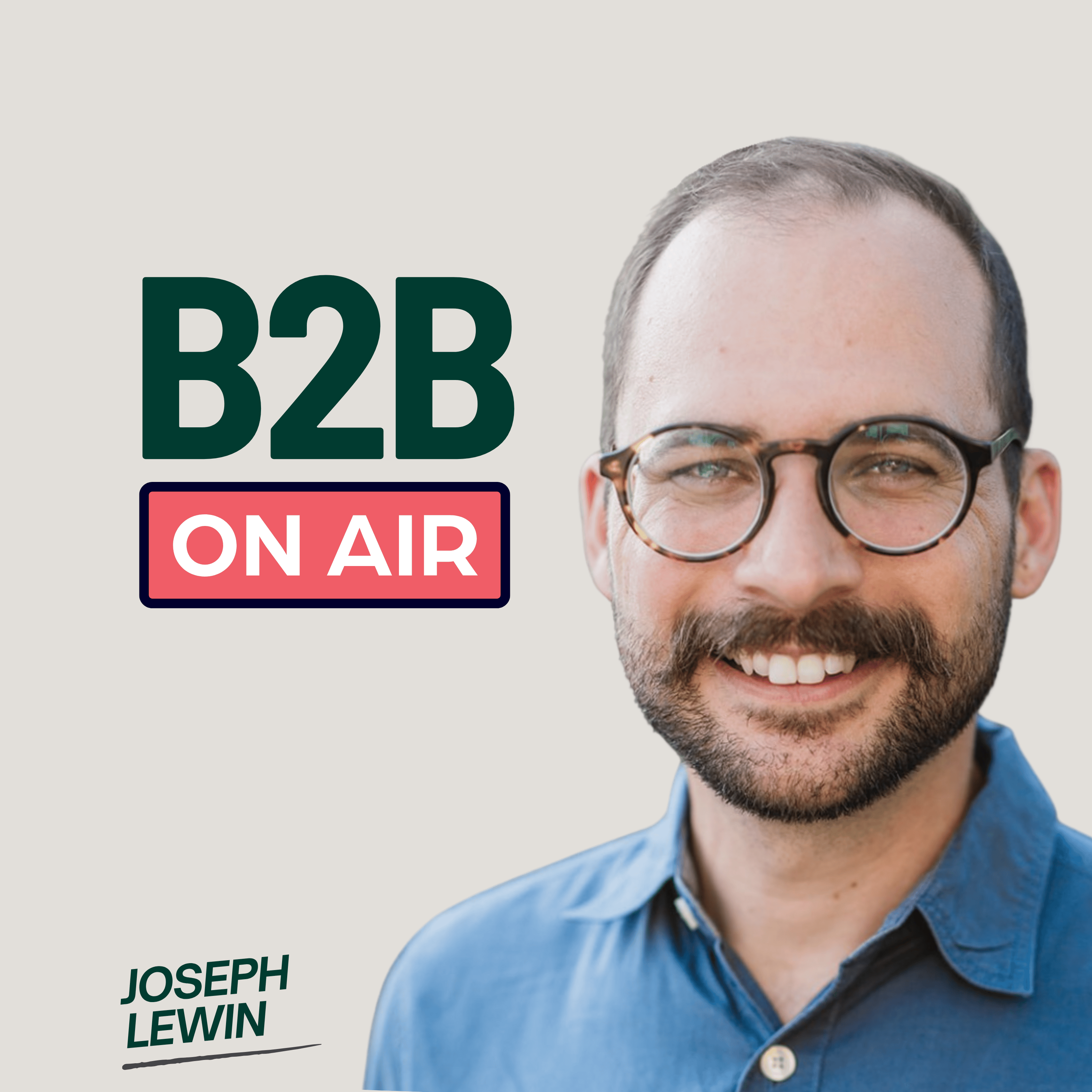
Welcome to B2B On Air!
Most B2B podcasts die before they ever open a single door worth opening.
Published April 22, 2026
Most B2B podcasts die before they ever open a single door worth opening.
Joseph Lewin has launched 45 B2B podcasts. The hosts he has worked with have generated well over $17 million in directly attributable revenue. That number is not an accident. It is the result of a specific approach: staying in motion long enough to let the math work, keeping episodes short enough that busy people actually finish them, and treating the show as a pipeline tool rather than a content project.
What should B2B podcast hosts know about building a show that actually generates revenue?
The short answer: most shows fail not because of bad content, but because the host quits before the results show up. Here is what separates the shows that close deals from the ones that go dark after six episodes.
- Longevity is the actual strategy: Most hosts never run their show long enough to see results. The hosts generating high-quality deals are a "proud few" who stay consistent when things get hard.
- Revenue is directly attributable: The $17 million figure Joseph cites is not estimated or inferred. It is directly attributable revenue, meaning hosts can trace specific deals back to specific episodes or conversations the show created.
- Short episodes respect the audience's time: Joseph keeps episodes under 10 minutes, and aims for under 5. Busy B2B buyers will not sit through a 90-minute interview to get one useful idea.
- The show is a conversation starter, not a broadcast: The goal is not passive listeners. It is feedback, dialogue, and real responses. Joseph explicitly asks listeners to hit him up on LinkedIn with what is working.
- Tactics, strategies, and ideas over theory: Every episode delivers something the listener can try. Not inspiration. Not storytelling for its own sake. Something actionable before they finish their commute.
- Momentum beats perfection: The friction of getting started is the real enemy. Very few people who talk about launching a podcast actually do it. Fewer still run it long enough to matter.
Why do so many B2B podcasts fail to generate pipeline?
The problem is not the format. It is the expectation.
Most B2B professionals start a podcast because they want to grow an audience, generate revenue, or create a content engine they can repurpose everywhere. Those are legitimate goals. But the gap between "I want those outcomes" and "I understand what it takes to get there" is where most shows collapse.
Joseph is direct about this:
"It's not that easy. And so very few people actually start. And there's a fraction of those people, a proud few, who run their podcast long enough to see results." Joseph Lewin
The shows that fail are not failing because of bad audio or a weak guest lineup. They are failing because the host treats the show like a campaign with a start and end date, rather than a long-term relationship-building asset. Pipeline does not come from one episode. It comes from the accumulation of trust built over many episodes, many conversations, and many moments where a prospect hears something that makes them think: this person gets my world.
The math is simple. The discipline to do the math is not.
How do you keep a B2B podcast going when results are slow to come?
The answer is to reduce the cost of consistency.
This is why episode length matters so much. If producing an episode takes two days of your week, you will stop. If it takes two hours, you will not. Joseph's commitment to keeping episodes under 10 minutes, ideally under 5, is not just about the listener's time. It is about the host's sustainability.
A short, focused episode that delivers one concrete idea is easier to produce, easier to finish, and easier to publish on a regular schedule. That regularity is what builds the authority that eventually opens doors.
The other piece is feedback loops. Joseph asks listeners to respond on LinkedIn. That is not a vanity metric play. It is a way to keep the show connected to real sales conversations, to understand what is resonating, and to stay motivated when the download numbers are not yet impressive. The human experience of hearing "I tried that and it worked" is what keeps a host in the game.
What does a B2B podcast actually do for your sales cycle?
A B2B podcast compresses the trust-building phase of a long sales cycle.
When a prospect has listened to 10 episodes of your show before you ever get on a call, they already know how you think. They know your framework. They know your values. The first conversation is not a cold introduction. It is a continuation of something they have already been part of.
This is the mechanism behind the $17 million in directly attributable revenue Joseph references. The show does not replace the sales process. It does the early work of the sales process at scale, without friction, without a calendar invite, and without a rep on the other end of the phone.
The authority the show builds is not abstract. It shows up in shorter sales cycles, warmer first calls, and deals that close because the prospect already trusts you before you ask for anything.
FAQ
How long should a B2B podcast episode be?
Joseph Lewin keeps his episodes under 10 minutes and aims for under 5. The reasoning is practical: B2B professionals are busy, and a short episode they finish is worth more than a long one they abandon. Consistency matters more than depth when you are building pipeline over time.
How many podcasts has Joseph Lewin launched?
Joseph has launched 45 B2B podcasts. The hosts he has worked with have generated over $17 million in directly attributable revenue, meaning specific deals that can be traced back to the show.
Why should a B2B company start a podcast instead of running ads?
A podcast builds trust over time in a way that an ad cannot. When a prospect has already spent time with your thinking before the first sales conversation, the sales cycle shortens and the close rate improves. The show does the early relationship work at scale.
What is the biggest reason B2B podcasts fail?
Most shows fail because the host stops before the results arrive. The audience, the authority, and the pipeline all take time to build. The hosts who see real revenue are the ones who stay consistent through the slow early period when momentum has not yet compounded.
What should every B2B podcast episode deliver?
According to Joseph, every episode should give the listener something they can actually try: a tactic, a strategy, or a concrete idea. Not inspiration. Not theory. Something actionable they can apply to their business before the episode is over.
The thesis of B2B On Air is straightforward. A podcast is not a content project. It is a revenue tool. The hosts who treat it that way, who stay consistent, keep episodes tight, and measure success in conversations and closed deals rather than downloads and followers, are the ones who end up on the right side of that $17 million number.
If you are thinking about starting a show, or you are already running one and wondering why the pipeline has not moved yet, the answer is almost always the same: stay in motion, reduce friction, and let the trust compound.
About the host

Joseph Lewin
Host of B2B On Air · The Podcast Launch Guy | 45 B2B Podcasts Launched | Hosts I’ve worked with have closed over $17M in revenue | 100 Million Views On My Personal Social Video
Transcript
Read the full transcript
Joseph Lewin [0:00]
B2B podcasting. Tell me you’re a nerd without telling me you’re a nerd. In all seriousness though, lots of people talk about starting a podcast for their business because they want to grow an audience, they want to generate revenue, or they want a way to consistently create content that they can break up into little pieces and distribute everywhere. But it’s not that easy. And so very few people actually start. And there’s a fraction of those people, a proud few, who run their podcast long enough to see results. To generate those amazing high-quality deals, to grow an audience that actually cares about what you’re talking about. And that’s you, or it’s going to be you. That’s why you’re here, and that’s why I’m excited that you’re here. Welcome to B2B On Air. I’m your host, Joseph Lewin. I’ve launched 45 B2B podcasts, and hosts that I’ve worked
with have generated well over $17 million in directly attributable revenue. So I’ve learned a thing or two about launching shows, about what it takes to actually keep shows going day in and day out when things get tough. But here’s the deal. If you’re doing podcasting or thinking about doing podcasting, you’re probably really busy. And so I’m going to keep these episodes under 10 minutes for sure. I’m gonna try my hardest to keep them under 5 minutes so that you can get a quick hit, either a tactic, a strategy, an idea, something you can try. And then I want your feedback. And so if you’re listening to this episode, you try something out, hit me up on LinkedIn and let me know what’s working for you. And with that, thanks so much for listening, and we’ll see you on the next episode.